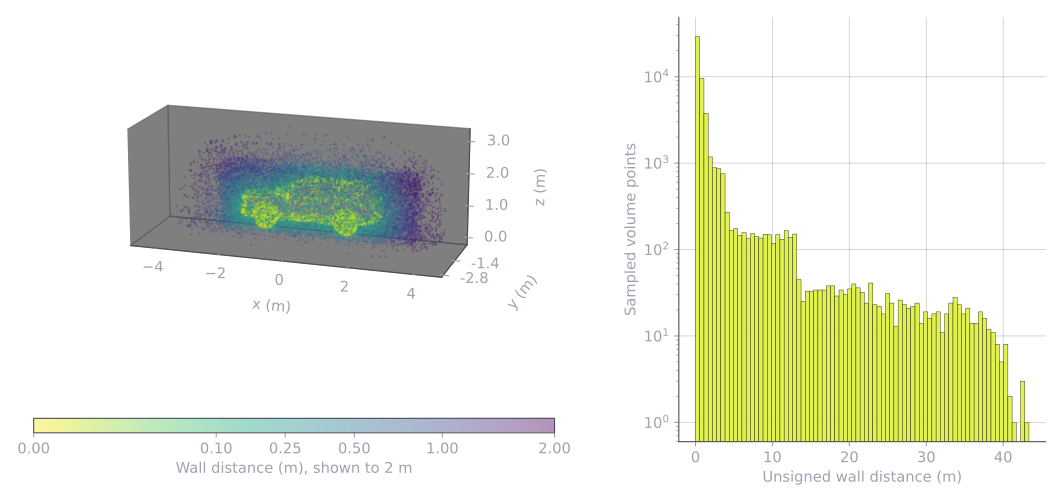
1 Unsigned distance to the vehicle surface
Let denote the vehicle surface. For volume point , the unsigned wall distance is
The volume points lie in the fluid region outside the vehicle surface. We therefore use the distance magnitude without classifying points as inside or outside.
We compute wall distance in physical coordinates. LIFT later centers the coordinates and divides each spatial axis by a different reference length. Computing distance after that anisotropic rescaling would change the Euclidean metric.
We map the physical distance to a bounded feature:
The scale is the weighted 99th percentile of wall distance in the training distribution. The transform preserves differences near the wall and bounds large distances without clipping them.
2 Wall distance enters the volume token
Let be LIFT's continuous coordinate embedding, a learned wall-distance embedding, and the volume-stream projection. The initial token is
The wall-distance embedding is added to the coordinate embedding before the volume-stream projection. This changes neither the number nor the width of the tokens. Surface tokens do not receive the feature because surface points lie on and have zero wall distance.
Before training, we compute and store one wall distance for each volume point. We evaluate the point-to-surface distance with NVIDIA Warp [2], using parallel closest-point queries against the vehicle triangle mesh. During training, the model reads the stored distances together with the coordinates and target fields; it does not recompute them.
| Volume points | CPU (14 cores) | A10 GPU (24 GB) | GPU speedup |
|---|---|---|---|
| 250k | 1.45–1.46 s | 0.46–0.47 s | 3.1× |
| 2M | 6.52–6.67 s | 0.65–0.66 s | 10.0–10.2× |
| 10M | 29.67–30.36 s | 1.50–1.51 s | 19.7–20.1× |
The GPU speedup increases with the number of points because the closest-point queries are independent and the fixed setup cost is amortized over a larger batch. At 10 million points, the A10 is approximately 20× faster than the CPU.
3 Experiments
We compare the baseline SUV-PT model with a model that adds wall-distance conditioning to the volume-point tokenization. We evaluate both models on SUV-Bench Medium and SUV-Bench Hard. We report mean-squared error (MSE) over the normalized volume-field channels , both over all volume points and over the near-wall subset
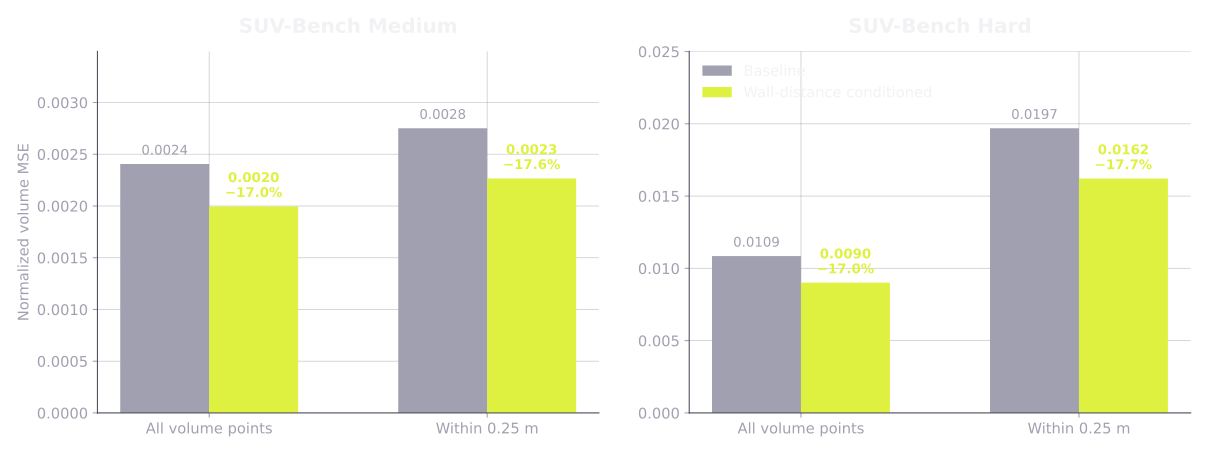
On SUV-Bench Medium, all-point volume MSE decreases from 0.00241 to 0.00200, and near-surface MSE decreases from 0.00275 to 0.00227. On SUV-Bench Hard, all-point MSE decreases from 0.01085 to 0.00901, and near-surface MSE decreases from 0.01969 to 0.01621. Velocity-vector relative L2 error also decreases by 7.4% on Medium and 7.8% on Hard, while volume-pressure relative L2 error is unchanged.
4 Discussion
Wall distance supplies geometric information that the model would otherwise have to infer from the training data. With the same training samples, it reduces all-point and near-surface volume MSE by approximately 17% and velocity-vector relative L2 error by 7–8%. The model therefore obtains more accurate volume predictions from the same simulation budget.
For engineers, the volume velocity field describes wake development, separation, recirculation, and flow around the wheels and underbody. Improving these quantities supports earlier comparison of design variants without generating additional high-fidelity CFD simulations. Since simulation data is expensive to produce, better accuracy from a fixed dataset improves the economics of training application-specific physics models.
For new physical query points, inference must compute wall distance before running LIFT. The GPU results show that this preprocessing step remains practical at high point counts.
References
- UniversalAGI. (2026). SUV-PT: Physics Transformer for SUVs. UniversalAGI Research. https://www.universalagi.com/research/suv-pt.
- NVIDIA. (n.d.). NVIDIA Warp. NVIDIA Developer. https://developer.nvidia.com/warp-python.